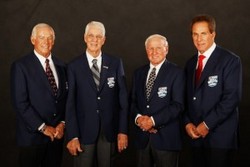
Glen Wood has become legendary for his contribution to NASCAR fame. Hailing from Stuart, VA, he has made great fame with race cars.
Source: RacinToday.com
By Deb Williams | Senior Writer
RacinToday.com
CHARLOTTE, N.C. – On a section of Wood family property in Stuart, Va., stands a majestic 153-year-old beech tree. Its sturdiness serves as a tribute to one of the most famous families in NASCAR racing for it was under its leafy branches that Glen Wood and his brothers pulled their first engine from a race car. On that unassuming, yet faithful day, they threw a chain over one of its stout limbs and proceeded to hoist the engine from the race car.
Friday night, 61 years later, the often shy, yet tough Glen Wood took his place in the NASCAR Hall of Fame. For the 86-year-old personable man often called “Woodchopper� during his driving days, induction into the NASCAR Hall of Fame is the exclamation point on a stellar career that has spanned NASCAR’s Modified, Sportsman, Convertible and Sprint Cup divisions on sand, asphalt and dirt. In 1954, the devout family man earned the North Carolina Sportsman championship and the track title at Bowman-Gray Stadium in Winston-Salem, N.C. He’s also fielded a winning pit crew in the Indianapolis 500.
“Not only did Glen win 96 races as a driver, but he provided the opportunity for a lot of young drivers to win their first race,� his youngest brother, Leonard, said Friday during his induction speech. “Seventy-five drivers have driven for the Wood Brothers, 20 of which were NASCAR’s 50 greatest drivers.
“They were having races on the beach back in 1947 before NASCAR was formed and he’s been to Daytona
Glen Wood at the Hall.
every year since. He had great success at Daytona Beach. He went down there three years in a row, he sat on the pole, won his class. In ’58 he sat on the pole and beat the record by 12 miles an hour – beat all the Modifieds, finished first, and then third overall. And, then, also, in ’59 he sat on the pole at the new (Daytona) track in a convertible race.�
Between being a driver and an owner, Glen’s outstanding career is among the longest in racing and his loyalty to Ford Motor Company is unmatched by any other team.
“Ford gave me a chance in 1956 when they asked me to be a part of the Ford racing team, which has led to this induction into the NASCAR Hall of Fame, and I’m proud to have been with Ford Motor Company for the last 60 years,� Glen said during his acceptance speech.
Glen stepped out of the driver’s seat in 1964, because he wasn’t interested in racing on the superspeedways that became more prevalent during the 1960s. His last victory came on July 13, 1963 at the quarter-mile Bowman-Gray Stadium in Winston-Salem. In that race, among those he defeated were 2011 NASCAR Hall of Fame inductees Ned Jarrett, Lee Petty and David Pearson, and 2010 NASCAR Hall of Fame inductees Richard Petty and Junior Johnson
A product of the Great Depression, Glen’s strong work ethic, his credibility, his foresight and his determination to “always do the right thing� have been instrumental in his perseverance in a sport filled with peaks and valleys.
“Glen was always fair, honest, gave good advice, needed no more than a handshake,� Leonard said about his “big brother� during the induction ceremony.
“He was a very intelligent businessman. He used sound judgment when he was making a decision about something. He never gave me any bad advice.�
Today, it’s those teachings – honoring your word and paying your bills – that Glen’s sons, Eddie and Len, and daughter Kim live by in running the family business.
Before focusing on racing, Glen worked in a physically demanding business – sawmilling – and, like his
brothers, hauled lumber.
In the beginning, Leonard, who was 15 when Glen started racing at age 25, was the chief mechanic. Glen
The newest class of the NASCAR Hall of Game: Dale Inman, Glen Wood, Cale Yarborough and Darrell Waltrip.
handled the business side and assisted Leonard in the shop. Brothers Ray and Delano traveled to the track on race day to join the pit crew. When Ray retired in 1965, their oldest brother, Clay, joined the over-the-wall crew. The thought to leave racing occurred on many occasions, but then a victory or a sponsor would be secured and the team would continue.
Loyalty is important to Glen and it’s that characteristic that has often paid dividends for the family-owned team when it comes to Ford Motor Company. From the time the second of five children began racing, nothing but a Ford or Ford product has called the race shop home. It’s a relationship that kept the team in business when it appeared on the edge of extinction.
The Wood’s relationship with Ford also led the family to international fame in the 1965 Indianapolis 500 when they introduced the open-wheel world to their trademark fast pit stops. By the time NASCAR reached its second decade, Glen and Leonard had realized it was easier to pass cars on pit road with a quick stop than on the race track. They didn’t invent pit stops, they simply refined them and it was a trait Ford needed for its 1965 Indianapolis 500 entry with Jim Clark.
“I know you guys have already figured it out that Glen and I both talk slow,� Leonard said Friday night. “We just learned recently that when they heard us talk (at Indianapolis), they were talking (among
The Wood Brothers service the Lotus of Colin Chapman and driver Jim Clark at Indianapolis in 1965. (Photo courtesy of The Wood Brothers Racing team)
themselves and said), ‘I sure hope they can pit faster than they’re talking.’�
In 1965, Glen and his family traveled to Indianapolis about two weeks before the race to re-engineer the cars’ fueling system. On race day, the family stunned the open-wheel community with its lightening fast stops. They not only pitted Clark that day, but also NASCAR regular Bobby Johns. Clark won the race in car No. 82, while Johns finished seventh in No. 83. It was the first win for Ford, the first for a rear-engine car and the first in which a driver averaged more than 150 mph for a 500-mile race.
“Their total time on pit road for two cars – four pit stops – was less than one pit stop for everybody else,� Eddie said. “It was unheard of.�
Two years after introducing their quick pit stops to an international audience, the Wood Brothers earned their first of three UNION 76/Rockingham Pit Crew Championships. Yarborough piloted the famous No. 21 for the 1967-68 titles, while Neil Bonnett handled the driving duties in 1981.
It was an era when race fans came to the realization that if an event contained a Cinderella or historical ending, the No. 21 was probably involved. Glen’s team won the inaugural National 400 at Charlotte Motor Speedway with Speedy Thompson in October 1960. Three years later Glen’s team won its first of five Daytona 500s with substitute driver Tiny Lund. It also was the first series victory for Lund, who just days earlier had helped save Marvin Panch, the team’s regular driver, from a burning Maserati that crashed while Panch was testing it at Daytona.